

Tuesday, January 27, 2026
Media Contact
Shannon Gray | shannon.gray@state.co.us | (970) 505-7937
Today, the U.S. Census Bureau published its vintage 2025 estimates for state populations as of July 1, 2025. These estimates are considered the “official” Census Bureau population estimates for years between the decennial census counts. Vintage 2025 county population estimates will be published in March, and municipal estimates in May 2026. The State Demography Office incorporates information from these estimates into their annual population estimates, which will be published in late October 2026.
U.S. Census Data: Key Takeaways
- Six million and counting. Colorado’s population reached and exceeded six million in the first half of 2025, reaching 6,012,561 by July 1, 2025. Colorado’s population continues to grow, increasing 0.4% over prior year levels. Comparatively, the nation as a whole grew 0.5% over the same period.
- Population growth was driven primarily by an increase in births. The number of births in Colorado between July 1, 2024 and June 30, 2025 was 65,380, which is a 4.6% increase over the 2023-2024 time period, and is the highest amount since 2017. Deaths remained near prior year levels, up 59 (0.1%).
- Net domestic and international migration. Slower migration growth similar to the majority of U.S states. Net international migration fell considerably from 2024 levels. Net domestic migration was negative (more outs than ins) in 2025 for the first time since 2004.
- Lower levels of net migration contributed to slowing of growth across a majority of US states. “Every state except Montana and West Virginia saw their growth slow, or their decline accelerate.” This is largely due to a historic decline in net international migration across the country.
- 12,100 more domestic migrants left Colorado than arrived between July 1, 2024 and June 30, 2025.
- 15,356 more international migrants arrived in Colorado than left between July 1, 2024 and June 30, 2025.
- Colorado’s total net migration, accounting for both domestic and international migration, was 3,256 over this period.
- Notably, once an international migrant has entered the United States, any future moves to other states (secondary migration) is counted as domestic migration. The large influx of international migrants to Colorado between 2022 and 2025 has been largely composed of humanitarian migrants, some of whom did not intend Colorado to be their final destination within the United States. At least some portion of the domestic out-migration from Colorado is made up of recently arrived international migrants.
Colorado Net Migration
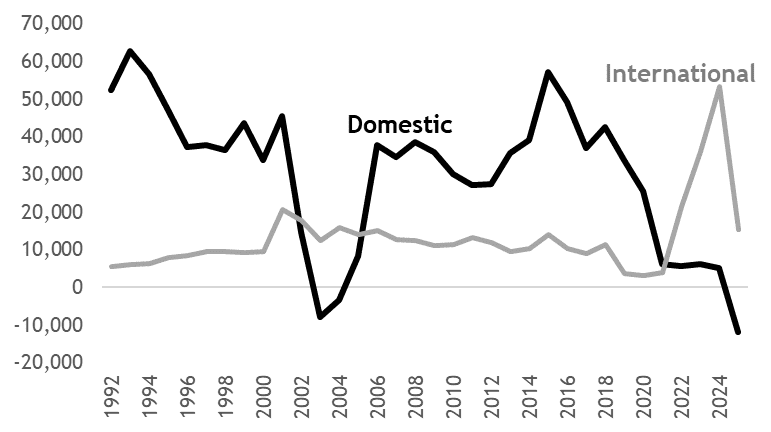
Chart Source: U.S. Census Bureau, Population Estimates Program. Note: A positive value represents more ins than outs, negative means more outs than ins.
- Revisions to prior years. The vintage 2025 estimates include relatively large upward revisions for prior years, in particular for net international migration in 2022 through 2024.
- Census Bureau press release
- Vintage 2025 tables